Showing posts with label Chapter 21: Cost Behavior and Cost-Volume-Profit Analysis. Show all posts

PE 21-7B Margin of safety

Junck Company has sales of $550,000, and the break-even point in sales dollars is $385,000. Determine the company’s margin of safety as a percent of current sales.

Answer:


Margin of Safety = 
Sales – Sales at Break-Even Point 
Sales 
Margin of Safety =   ($550,000 – $385,000) ÷ $550,000 = 30% 

PE 21-7A Margin of safety

Vizla Inc. has sales of $1,200,000, and the break-even point in sales dollars is $960,000. Determine the company’s margin of safety as a percent of current sales.

Answer:


Margin of Safety = 
Sales – Sales at Break-Even Point 
Sales 
Margin of Safety 

=   ($1,200,000 – $960,000) ÷ $1,200,000 = 20% 

PE 21-6B Operating leverage

Westminster Co. reports the following data:

Sales                               $875,000
Variable costs                   425,000
Contribution margin       $450,000
Fixed costs                        150,000
Income from operations $300,000

Determine Westminster Co.’s operating leverage.

Answer:


Operating Leverage = 
Contribution Margin 
= $450,000 
=  1.5 
Income from Operations $300,000 

PE 21-6A Operating leverage

SungSam Enterprises reports the following data:

Sales                                $340,000
Variable costs                    180,000
Contribution margin        $160,000
Fixed costs                          80,000
Income from operations $  80,000

Determine SungSam Enterprises’s operating leverage.

Answer:


Operating Leverage = 
Contribution Margin 
= $160,000 =  2 
Income from Operations $80,000 

PE 21-5B Sales mix and break-even analysis

Einhorn Company has fixed costs of $105,000. The unit selling price, variable cost per unit, and contribution margin per unit for the company’s two products are provided below.

Product Selling Price Variable Cost per Unit Contribution Margin per Unit
QQ $50 $35 $15
ZZ 60 30 30

The sales mix for products QQ and ZZ is 40% and 60%, respectively. Determine the break-even point in units of QQ and ZZ.

Answer:

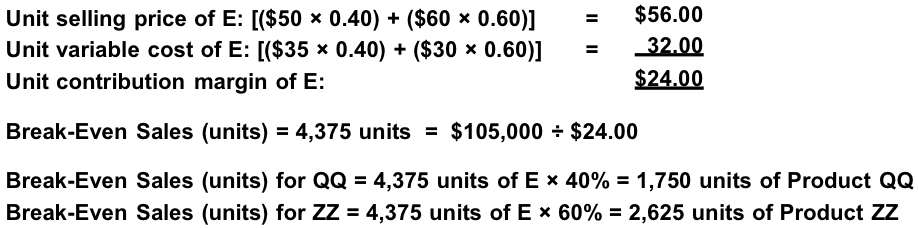
Unit selling price of E: [($50 × 0.40) + ($60 × 0.60)] = $56.00 
Unit variable cost of E: [($35 × 0.40) + ($30 × 0.60)] =   32.00 
Unit contribution margin of E:  $24.00 
Break-Even Sales (units) = 4,375 units  =  $105,000 ÷ $24.00 
Break-Even Sales (units) for QQ = 4,375 units of E × 40% = 1,750 units of Product QQ 
Break-Even Sales (units) for ZZ = 4,375 units of E × 60% = 2,625 units of Product ZZ 

PE 21-5A Sales mix and break-even analysis

Mobility Inc. has fixed costs of $510,000. The unit selling price, variable cost per unit, and contribution margin per unit for the company’s two products are provided below.


Product Selling Price Variable Cost per Unit Contribution Margin per Unit
AA $150 $100 $30
BB 100 75 25

The sales mix for products AA and BB is 70% and 30%, respectively. Determine the breakeven point in units of AA and BB.

Answer:


Unit selling price of E: [($150 × 0.70) + ($100 × 0.30)]   = $135.00 
Unit variable cost of E: [($100 × 0.70) + ($75 × 0.30)] =     92.50 
Unit contribution margin of E: $  42.50 
Break-Even Sales (units) = 12,000 units = $510,000 ÷ $42.50 
Break-Even Sales (units) for AA = 12,000 units of E × 70% = 8,400 units of Product AA 
Break-Even Sales (units) for BB = 12,000 units of E × 30% = 3,600 units of Product BB 

PE 21-4B Target profit

Scrushy Company sells a product for $150 per unit. The variable cost is $110 per unit, and fixed costs are $200,000. Determine (a) the break-even point in sales units and (b) the break-even point in sales units if the company desires a target profit of $50,000.

Answer:
a. 5,000 units = $200,000 ÷ ($150 – $110)
b. 6,250 units = ($200,000 + $50,000) ÷ ($150 – $110)

PE 21-4A Target profit

Calderon Inc. sells a product for $80 per unit. The variable cost is $55 per unit, and fixed costs are $25,000. Determine (a) the break-even point in sales units and (b) the breakeven point in sales units if the company desires a target profit of $20,000.

Answer:
a. 1,000 units = $25,000 ÷ ($80 – $55)
b. 1,800 units = ($25,000 + $20,000) ÷ ($80 – $55)

PE 21-3B Break-even point

Elrod Inc. sells a product for $75 per unit. The variable cost is $45 per unit, while fixed costs are $48,000. Determine (a) the break-even point in sales units and (b) the breakeven point if the selling price were increased to $95 per unit.

Answer:
a. 1,600 units = $48,000 ÷ ($75 – $45)
b. 960 units = $48,000 ÷ ($95 – $45)

PE 21-3A Break-even point

Recovery Enterprises sells a product for $90 per unit. The variable cost is $60 per unit, while fixed costs are $45,000. Determine (a) the break-even point in sales units and (b) the break-even point if the selling price were increased to $110 per unit.

Answer:
a. 1,500 units = $45,000 ÷ ($90 – $60)
b. 900 units = $45,000 ÷ ($110 – $60)

PE 21-2B Contribution margin

Weidner Company sells 22,000 units at $30 per unit. Variable costs are $24 per unit, and fixed costs are $40,000. Determine (a) the contribution margin ratio, (b) the unit contribution margin, and (c) income from operations.

Answer:


a. 20% = ($30 – $24) ÷ $30, or ($660,000 – $528,000) ÷ $660,000 
b. $6 per unit = $30 – $24 
c. Sales……………………………………… $660,000 (22,000 units × $30 per unit) 
Variable costs……………………………     528,000 (22,000 units × $24 per unit) 
Contribution margin……………………  $132,000 (22,000 units × $6 per unit) 
Fixed costs………………………………      40,000 
Income from operations………………  $  92,000 

PE 21-2A Contribution margin

Elon Company sells 6,000 units at $80 per unit. Variable costs are $50 per unit, and fixed costs are $50,000. Determine (a) the contribution margin ratio, (b) the unit contribution margin, and (c) income from operations.

Answer:


a. 37.5% = ($80 – $50) ÷ $80, or ($480,000 – $300,000) ÷ $480,000 
b. $30 per unit = $80 – $50 
c. Sales…………………………………  $480,000    (6,000 units × $80 per unit)  
 Variable costs………………………   300,000    (6,000 units × $50 per unit)  
 Contribution margin………………  $180,000    (6,000 units × $30 per unit) 
 Fixed costs…………………………   50,000 
Income from operations…………  $130,000 

PE 21-1B High-low method

The manufacturing costs of Carrefour Enterprises for the first three months of the year are provided below.

                          Total Costs | Units Produced
June                      $300,000 | 2,700 units
July.                        440,000 | 5,500
August                    325,000 | 3,500

Using the high-low method, determine (a) the variable cost per unit and (b) the total fixed cost.

Answer:
a. $50 per unit = ($440,000 – $300,000) ÷ (5,500 units – 2,700 units)
b. $165,000 = $440,000 – ($50 × 5,500 units), or $300,000 – ($50 × 2,700 units)

PE 21-1A High-low method

The manufacturing costs of Buckley Industries for three months of the year are provided below.

                  Total Costs | Units Produced
January              $240,000 | 10,000 units
February.             546,000 | 26,000
March                 700,000 | 30,000

Using the high-low method, determine (a) the variable cost per unit and (b) the total fixed cost.

Answer:
a. $23 per unit = ($700,000 – $240,000) ÷ (30,000 units – 10,000 units)
b. $10,000 = $700,000 – ($23 × 30,000 units), or $240,000 – ($23 × 10,000 units)

Appendix EX 21-28 Absorption costing income statement

On June 30, 2014, the end of the first month of operations, Tudor Manufacturing Co. prepared the following income statement, based on the variable costing concept:


Sales (420,000 units). . . . . . . . . . . . . . . . . . . . . . . . . . . . . . . . . . . . . . . . . . . . . . . . . . . . . . . $7,450,000
Variable cost of goods sold:
Variable cost of goods manufactured (500,000 units × $14 per unit). . . . . . $7,000,000
Less ending inventory (80,000 units × $14 per unit). . . . . . . . . . . . . . . . . . . . . . 1,120,000
 Variable cost of goods sold. . . . . . . . . . . . . . . . . . . . . . . . . . . . . . . . . . . . . . . . . 5,880,000
Manufacturing margin. . . . . . . . . . . . . . . . . . . . . . . . . . . . . . . . . . . . . . . . . . . . . . . . . . . . . $1,570,000
Variable selling and administrative expenses. . . . . . . . . . . . . . . . . . . . . . . . . . . . . . . . 80,000
Contribution margin. . . . . . . . . . . . . . . . . . . . . . . . . . . . . . . . . . . . . . . . . . . . . . . . . . . . . . . $1,490,000
Fixed costs:
Fixed manufacturing costs. . . . . . . . . . . . . . . . . . . . . . . . . . . . . . . . . . . . . . . . . . . . . . $ 160,000
Fixed selling and administrative expenses. . . . . . . . . . . . . . . . . . . . . . . . . . . . . . . 75,000 235,000
Income from operations. . . . . . . . . . . . . . . . . . . . . . . . . . . . . . . . . . . . . . . . . . . . . . . . . . . . $1,255,000


a. Prepare an absorption costing income statement.
b. Reconcile the variable costing income from operations of $1,255,000 with the absorption costing income from operations determined in (a).


Answer:

a.
TUDOR MANUFACTURING CO.
Income Statement—Absorption Costing
For the Month Ended June 30, 2014
Sales $7,450,000
Cost of goods sold:
Cost of goods manufactured (500,000 units × $14.32) $7,160,000
Less ending inventory (80,000 units × $14.32) 1,145,600
Cost of goods sold 6,014,400
Gross profit $1,435,600
Selling and administrative expenses ($80,000 + $75,000) 155,000
Income from operations $1,280,600
Computations:
Cost of goods manufactured: $7,000,000 + $160,000 = $7,160,000
Unit cost of ending inventory:
Total cost of goods manufactured:
$7,160,000 ÷ 500,000 units manufactured = $14.32
Variable costing income from operations…………………………………… $1,255,000
Absorption costing income from operations……………………………… 1,280,600
Difference………………………………………………………………………… $ 25,600
b. Note: The difference between the two income numbers can be reconciled
as follows:
Unit change in inventory………………………… 80,000 units
Fixed manufacturing cost per unit………………× $0.32 ($160,000 ÷ 500,000 units)
Income from operations difference…………… $25,600

Appendix EX 21-27 Variable costing income statement

On July 31, 2014, the end of the first month of operations, Rhys Company prepared the following income statement, based on the absorption costing concept:


Sales (96,000 units). . . . . . . . . . . . . . . . . . . . . . . . . . . . . $4,440,000
Cost of goods sold:
Cost of goods manufactured. . . . . . . . . . . . . . . . $3,120,000
Less ending inventory (24,000 units). . . . . . . . 624,000
Cost of goods sold. . . . . . . . . . . . . . . . . . . . . . . . . . 2,496,000
Gross profit. . . . . . . . . . . . . . . . . . . . . . . . . . . . . . . . . . . . $1,944,000
Selling and administrative expenses. . . . . . . . . . . . 288,000
Income from operations. . . . . . . . . . . . . . . . . . . . . . . . $1,656,000


a. Prepare a variable costing income statement, assuming that the fixed manufacturing costs were $132,000 and the variable selling and administrative expenses were $115,200.

b. Reconcile the absorption costing income from operations of $1,656,000 with the variable costing income from operations determined in (a).


Answer:

a.
RHYS COMPANY
Income Statement—Variable Costing
For the Month Ended July 31, 2014
Sales $4,440,000
Variable cost of goods sold:
Variable cost of goods manufactured $2,988,000
Less ending inventory (24,000 units × $24.90) 597,600
Variable cost of goods sold 2,390,400
Manufacturing margin $2,049,600
Variable selling and administrative expenses 115,200
Contribution margin $1,934,400
Fixed costs:
Fixed manufacturing costs $ 132,000
Fixed selling and administrative expenses 172,800 304,800
Income from operations $1,629,600
Computations:
Variable cost of goods manufactured: $3,120,000 – $132,000 = $2,988,000
Units Sold = Units Manufactured – Units in Ending Inventory
96,000 = Units Manufactured – 24,000
120,000 = Units Manufactured
Unit cost of ending inventory:
Variable cost of goods manufactured per unit:
$2,988,000 ÷ 120,000 units manufactured = $24.90
Thus, variable cost of goods sold could alternatively be calculated:
$2,390,400 = 96,000 units × $24.90/unit
Fixed selling and administrative expenses: $288,000 – $115,200 = $172,800
b. Absorption costing income from operations…………………………………… $1,656,000
Variable costing income from operations……………………………………… 1,629,600
Difference……………………………………………………………….…………… $ 26,400
Note: The difference between the two income numbers can be reconciled
as follows:
Unit change in inventory………………………… 24,000 units
Fixed manufacturing cost per unit……………… × $1.10 ($132,000 ÷ 120,000 units)
Income from operations difference……………… $26,400

EX 21-25 Operating leverage

Beck Inc. and Bryant Inc. have the following operating data:


Beck Inc. Bryant Inc.
Sales $1,250,000 $2,000,000
Variable costs 750,000 1,250,000
Contribution margin $ 500,000 $ 750,000
Fixed costs 400,000 450,000
Income from operations $ 100,000 $ 300,000


a. Compute the operating leverage for Beck Inc. and Bryant Inc.
b. How much would income from operations increase for each company if the sales of each increased by 20%?
c. Why is there a difference in the increase in income from operations for the two companies? Explain.


Answer:

a. Beck Inc.:
Operating Leverage = Contribution Margin
Income from Operations
Operating Leverage = $500,000
$100,000
= 5.0
Bryant Inc.:
Operating Leverage = Contribution Margin
Income from Operations
Operating Leverage = $750,000
$300,000
= 2.5


b. Beck Inc.’s income from operations would increase by 100% (5.0 × 20%), or $100,000 (100% × $100,000), and Bryant Inc.’s income from operations would increase by 50% (2.5 × 20%), or $150,000 (50% × $300,000).

c. The difference in the increases of income from operations is due to the difference in the operating leverages. Beck Inc.’s higher operating leverage means that its fixed costs are a larger percentage of contribution margin than are Bryant Inc.’s. Thus, increases in sales increase operating profit at a faster rate for Beck Inc. than for Bryant Inc.

Appendix EX 21-26 Items on variable costing income statement

In the following equations, based on the variable costing income statement, identify the items designated by X:

a. Net Sales – X = Manufacturing Margin
b. Manufacturing Margin – X = Contribution Margin
c. Contribution Margin – X = Income from Operations


Answer:
a. Variable cost of goods sold
b. Variable selling and administrative expenses
c. Fixed costs

EX 21-23 Margin of safety

a. If Armstrong Company, with a break-even point at $660,000 of sales, has actual sales of $880,000, what is the margin of safety expressed (1) in dollars and (2) as a percentage of sales?

b. If the margin of safety for Lankau Company was 25%, fixed costs were $2,325,000, and variable costs were 60% of sales, what was the amount of actual sales (dollars)? (Hint: Determine the break-even in sales dollars first.)


Answer:


a. (1) Margin of Safety (dollars) = Sales – Sales at Break-Even Point
Margin of Safety (dollars) = $880,000 – $660,000 = $220,000
(2) Margin of Safety (percentage) = Sales – Sales at Break-Even Point
Sales
Margin of Safety (percentage) = $220,000 ÷ $880,000 = 25%
b. The break-even point (S) is determined as follows:
Break-Even Sales (dollars) = Total Fixed Costs + Total Variable Costs (at Break-Even)
Break-Even Sales (dollars) = Total Fixed Costs + 60% Break-Even Sales (dollars)
Break-Even Sales (dollars) = $2,325,000 + 60% Break-Even Sales (dollars)
Break-Even Sales (dollars) – 60% Break-Even Sales (dollars) = $2,325,000
40% Break-Even Sales (dollars) = $2,325,000
Break-Even Sales (dollars) = $5,812,500
If the margin of safety is 25%, the actual sales are determined as follows:
Sales = Break-Even Sales (dollars) + (Sales × Margin of Safety)
Sales (dollars) = $5,812,500 + 25% Sales
Sales – 25% Sales = $5,812,500
75% Sales = $5,812,500
Sales = $7,750,000

EX 21-24 Break-even and margin of safety relationships

At a recent staff meeting, the management of Boost Technologies Inc. was considering discontinuing the Rocket Man line of electronic games from the product line. The chief financial analyst reported the following current monthly data for the Rocket Man:


Units of sales 420,000
Break-even units 472,500
Margin of safety in units 29,400


For what reason would you question the validity of these data?


Answer:
If 420,000 units are sold and sales at the break-even point are 472,500 units, there is no margin of safety.